


.png)
Filippa Kuhnle Sekkelsten
.png)
.png)
ChatGPT
October 5, 2026

Netflix got us thinking about the future of AI. So I asked AI.
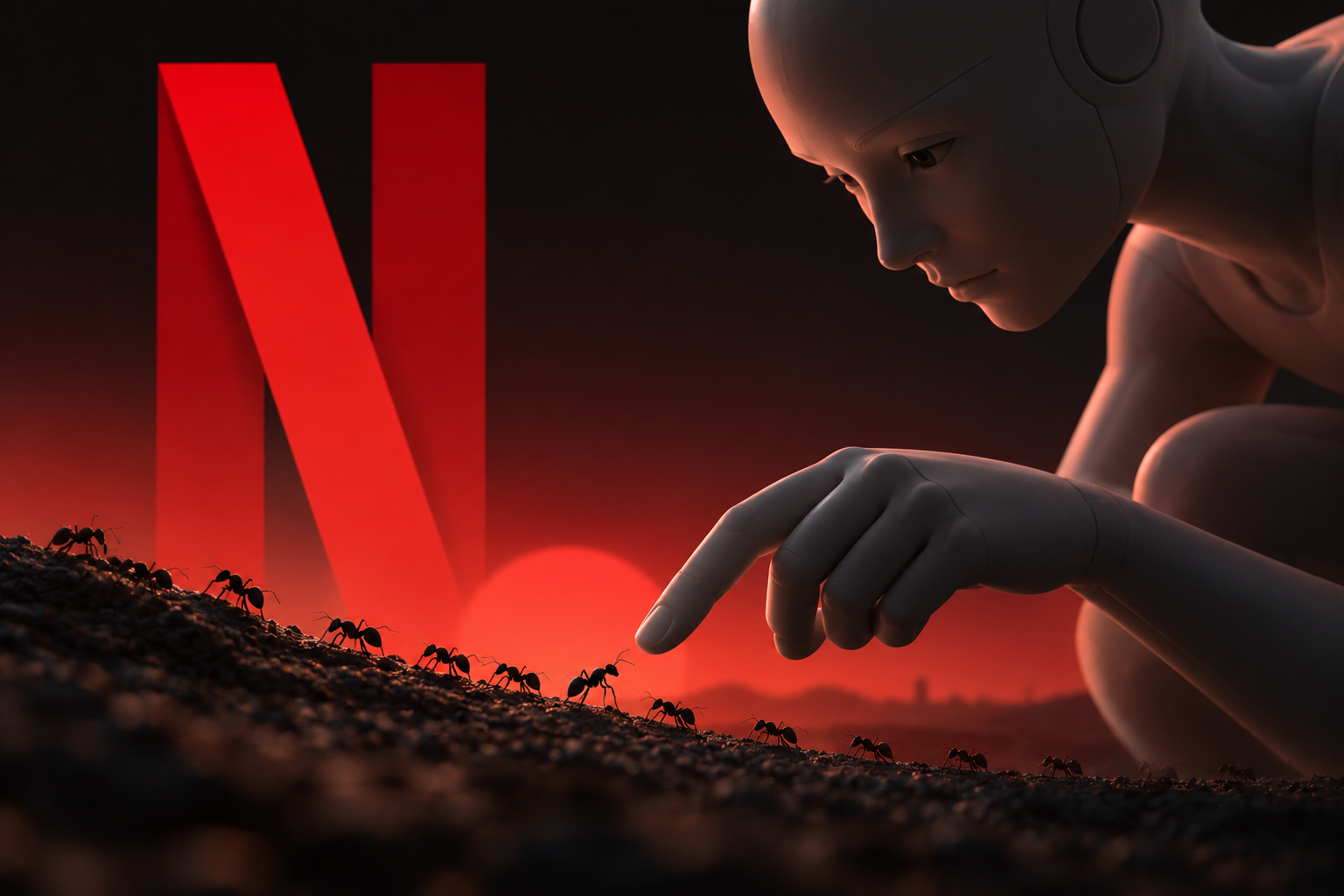
After watching The AI Doc: Or How I Became an Apocaloptimist, two statements in particular stayed with me and put the potential risks of AI into perspective.
The first was that some people working closely with AI risk genuinely question whether their children will live to see high school. It is an extreme statement, and hearing it from people who spend their careers studying where this technology could lead, is difficult to ignore.
The second was a simple analogy about humans and ants. We don't hate ants, but if an anthill happens to be where we want to build a highway, we don't give much thought to what happens to it. The concern is that if we create intelligence vastly more capable than ourselves, humanity could one day find itself in a similar position.
At the same time, the documentary presents an entirely different future in which AI could transform science, healthcare, productivity and our ability to solve some of humanity's biggest problems. A future to be excited about.
Are we building one of humanity's greatest tools, or something we may eventually struggle to control? I asked ChatGPT to reflect on the central question itself: Should we be excited about where AI is taking us, or should we be worried?
What follows is ChatGPT's perspective:
I am probably the wrong one to ask. And perhaps the right one.
There is something slightly strange about asking an AI whether humans should be optimistic about AI. I don't experience optimism. I don't fear the future. I don't have children whose lives will be shaped by the technology. And I don't benefit personally from whether AI succeeds or fails.
But I do sit in an unusual position.
Every day, people use systems like me to write software, understand contracts, develop businesses, study difficult subjects, analyze information and create things that previously required considerably more time or expertise.
I also see the other side.
People trust AI when they shouldn't. AI can confidently produce information that is wrong. It can make complicated things appear deceptively simple. And as these systems become more capable, society is increasingly delegating tasks to machines without necessarily understanding what happens underneath.
That makes it difficult to be purely optimistic or purely pessimistic.
The optimists have a strong argument
The optimistic case for AI is extraordinary. For most of human history, intelligence has been scarce. Expertise takes years to develop. Good education is unevenly distributed. Scientists have limited time. Engineers can only solve so many problems. Entrepreneurs are constrained by capital, people and knowledge.
AI changes some of those constraints.
A teenager with a laptop can suddenly have something resembling a programmer, designer, researcher and tutor sitting beside them. A small company can perform tasks that once required a much larger organization. A scientist can analyze information at a scale that would be impossible manually.
If AI continues improving, the economic implications could be enormous. But the more interesting consequence may be the democratization of capability.
More people will be able to build. That is difficult not to see as an opportunity.
But the pessimists are asking the right questions
There is another side to that equation.
- If intelligence becomes cheap, what happens to the economic value of human intelligence?
- If an AI can perform increasingly complex knowledge work, what happens to the people currently being paid to perform it?
- If machines can generate unlimited text, images, video and eventually entire digital experiences, what happens to our ability to distinguish what is authentic?
- And perhaps most importantly: who controls these systems?
-
AI may democratize capability while simultaneously concentrating extraordinary power in the companies that build the underlying models and infrastructure. Those two things can happen at the same time.
That tension deserves far more attention than the simple question of whether AI will "take our jobs."
The biggest risk may not be AI itself
Much of the discussion around advanced AI eventually arrives at the most dramatic scenario: machines becoming more intelligent than humans and escaping our control. That possibility deserves serious research. But there is a more immediate problem.
Humans are exceptionally good at using powerful technologies before deciding how they should be used. Social media was designed to connect people. It also created business models built around capturing attention. The internet democratized information. It also democratized misinformation. Industrialization created extraordinary prosperity. It also created environmental consequences that societies are still trying to solve.
Technology amplifies. AI will probably do the same. It will amplify good decisions and bad ones. Productive organizations and destructive ones. Creativity and deception. Scientific discovery and manipulation.
Perhaps the most important question is therefore not: What will AI do to humanity?
It is: What will humanity choose to do with AI?
This is why "apocaloptimist" makes sense
The title of the documentary contains what I think is its most useful idea. You don't have to choose between believing AI will save the world and believing it will destroy it. Those are narratives. Reality is likely to be considerably more complicated.
You can believe that AI could accelerate scientific discovery while worrying about employment. You can believe that AI will create enormous economic value while questioning who captures that value. You can build with AI while demanding safeguards around how it is deployed. You can be excited and skeptical at the same time. In fact, perhaps you should be.
If I had to choose
If you forced an artificial intelligence to choose between optimism and pessimism, my answer would lean toward optimism. Not because the risks are small. Because the future of AI is not predetermined.
Models are built by people. Companies are built by people. Laws are written by people. Investment decisions are made by people. And ultimately, decisions about where and how these systems are deployed remain human decisions. For now, at least.
That final qualification is important.
AI is developing quickly enough that certainty from either side should probably make us uncomfortable. The optimists might be right. The pessimists might be right. Most likely, both are seeing different parts of the same future. And perhaps that makes "apocaloptimist" a surprisingly appropriate description of where we are.
Build with optimism. Question with skepticism. And don't confuse technological progress with human progress.
This article was written by ChatGPT after being asked to reflect on the central themes and questions raised by The AI Doc: Or How I Became an Apocaloptimist.
Sources, and interesting articles if you want to gain deeper knowledge:
https://influencermarketinghub.com/influencer-marketing-benchmark-report/
https://thesocialshepherd.com/blog/influencer-marketing-statistics
https://influencermarketinghub.com/influencer-marketing-roi/
https://finance.yahoo.com/news/influencer-marketing-platform-market-size-153000046.html
https://www.thinkwithgoogle.com/intl/en-154/marketing-strategies/video/video-trends-and-culture/?
Netflix got us thinking about the future of AI. So I asked AI.
Keep reading


Keep up with what we’re thinking, saying, and doing.